Giving Flowers
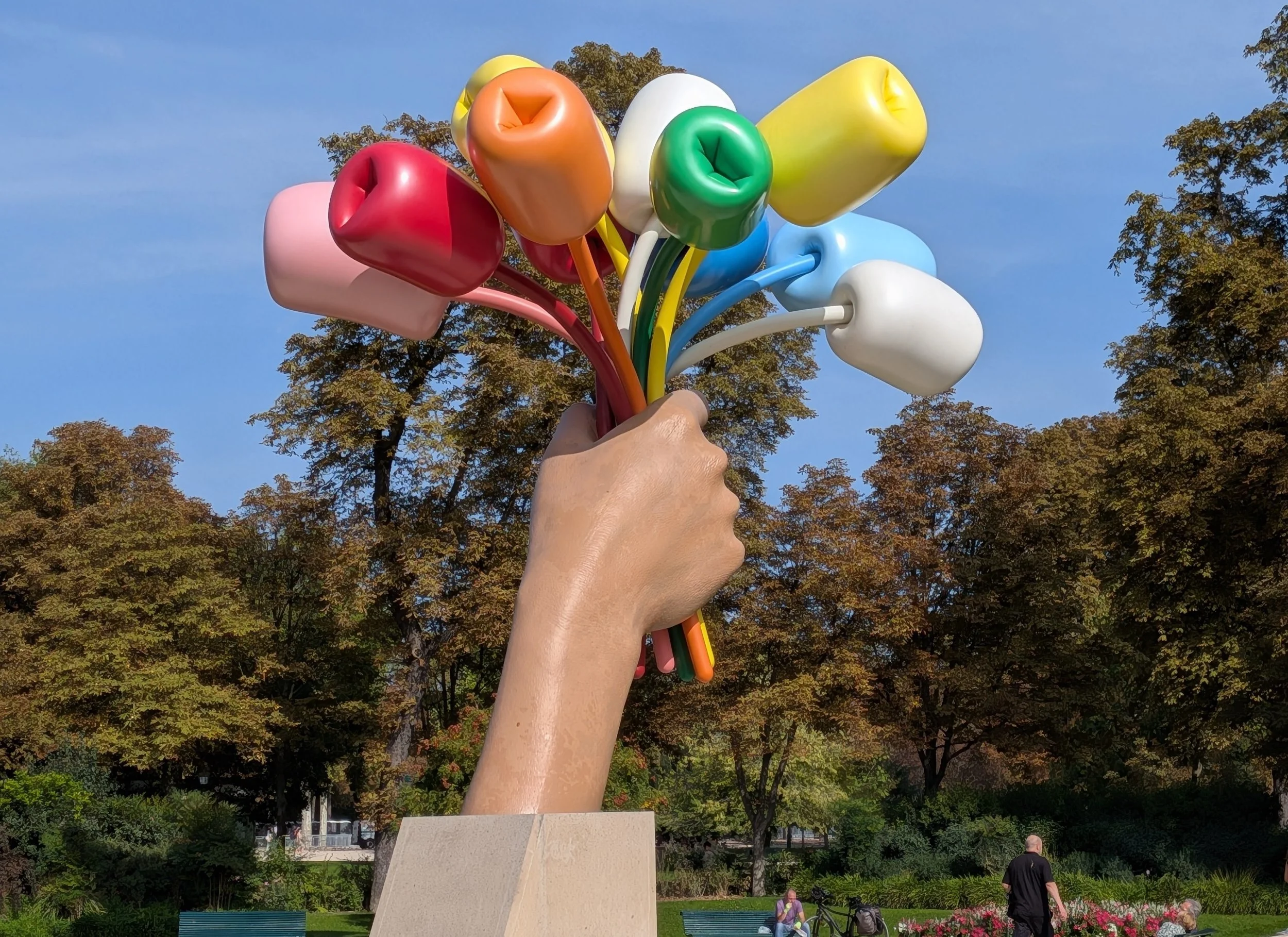
'Bouquet of Tulips' by Jeff Koons. Photo by Susan Cadell.
Have you heard the expression ‘to give someone flowers’ or simply, ‘giving flowers’? It means giving credit or compliments, for instance to honor people especially while they are still alive to hear it. When I saw the Bouquet of Tulips statue in Paris last week (and took the picture), it occurred to me that ‘giving flowers’ is a perfect way to help tie together recent thoughts I’ve been having.
My first flowers are for my brilliant international colleagues.
Mary Ellen and I just attended the 3rd European Grief and Bereavement conference in Porto, Portugal.
One flower goes to Lauren Breen. Among her many projects, she did a keynote about her work with young people and grief. They worked together to discuss grief literacy and made videos and infographics. For me, the most important piece was the young people’s choice not to use the word ‘literacy’ and instead to use ‘aware’.
Going forward, I want to use grief aware more often.
Mary Ellen and I were part of a symposium with Orla Keegan, Samar Aoun, Yong Hao Ng, and Geok Ling. Orla is from Ireland and she was there in person. Samar is Australian, Yong Hao and Geok Ling are from Singapore, and they all participated through a video presentation.
My flowers are for Orla and Ireland, where they are doing fantastic work with grief at all levels: from local to national. Orla was also one of the organisers of the conference, and it was very well done.
Geok Ling gets flowers for the work that they are doing with grief literacy in palliative care in Singapore.
A large bouquet of flowers goes to Samar and Yong Hao who were presenting their amazing work looking at how Public Health Model of Bereavement Support has been used around the world.
The original model looks like this and has been a major inspiration for our work in Canada.
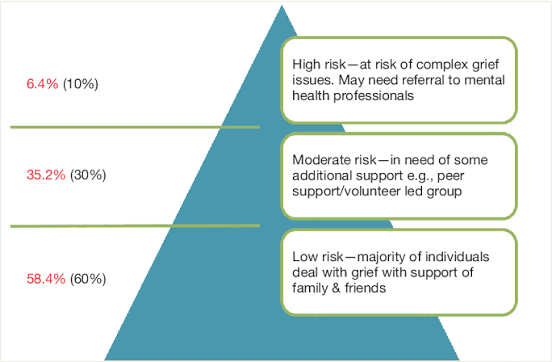
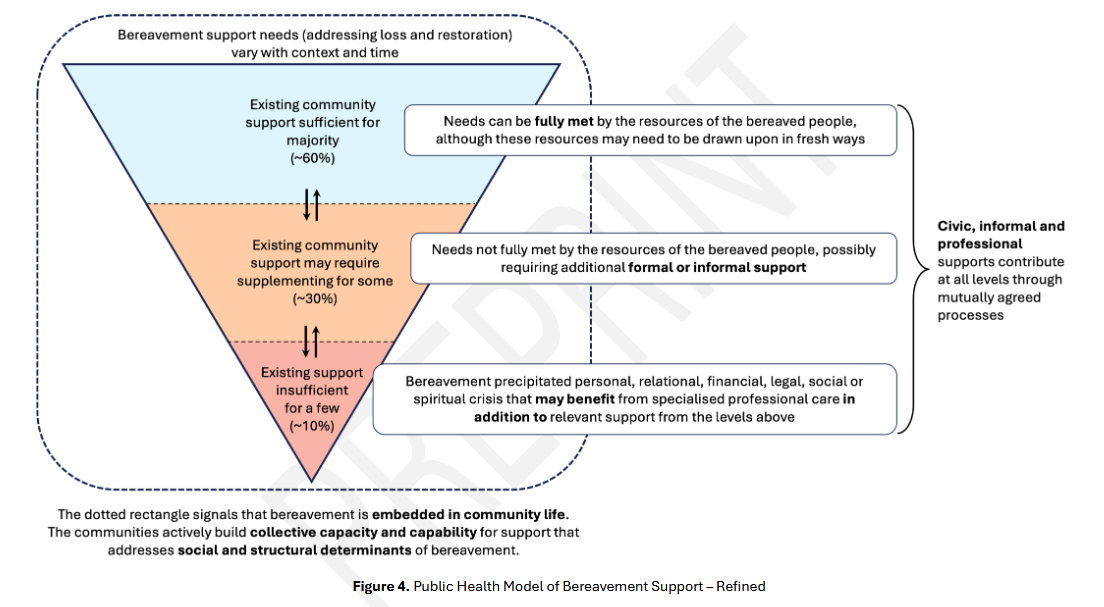
With this newest work, which you can read in full here, they have literally turned their thinking on its head: the triangle is now inverted. The authors have noted that the original model made the risk of complicated grief the pinnacle. The new model centres community care by putting it at the top. They made many revisions using very careful language. My favorite part is re-framing that people ‘may benefit’ from, and not that they ‘require’ additional services in the bottom two tiers. I like this because I have experienced the original model being framed in that prior way; further, the authors support this reframing with their careful work that has led to up to the revised model.
Now the model looks like this:
Why does this matter so much to me and to Grief Matters? At its heart, Grief Matters began because Mary Ellen and I, both academics and researchers at heart, are passionate about bridging the gap between scholarly and public knowledge of grief.
Which brings me to my final flower. I want to give flowers to my brilliant co-founder and co-conspirator Mary Ellen Macdonald.
After Portugal I spent two weeks in a tiny village in France in a house that has been in my husband’s family for generations. My mother-in-law loved that house and spent a lot of time there when she was alive. I loved my mother-in-law and that home in that village is where I feel closest to her.
So what does that have to do with Mary Ellen? She wrote and speaks about the presence of absence and our ghosts. These concepts become more than just ideas to me when I am in that village. I don’t just miss my mother-in-law when I am there. I cherish the connection to her. I feel her presence in her absence in that house that she so fully inhabited.
Mary Ellen’s thinking about how we can be in relationship to our ghosts has helped me to appreciate how much love and gratitude I feel for what I both have and had in my relationship with my mother-in-law.
For that I give Mary Ellen flowers.
Whether you call it giving flowers, compliments, or credit, just remember one thing: do it. Tell someone when you appreciate them or something that they did. Maybe even tell someone you love them. Before it is too late for you to know that they hear.